Adapting a Stackable Toy - Final Project Documentation
Adapting a Stackable Toy - Final Project Documentation
Adapting a Stackable Toy - Final Project Documentation
Delve into our journey of innovation and adaptation as we unveil the intricate processes, from meticulous design decisions to hands-on crafting challenges, that transformed a conventional stackable toy into an accessible learning tool for children with diverse needs.
Delve into our journey of innovation and adaptation as we unveil the intricate processes, from meticulous design decisions to hands-on crafting challenges, that transformed a conventional stackable toy into an accessible learning tool for children with diverse needs.
Delve into our journey of innovation and adaptation as we unveil the intricate processes, from meticulous design decisions to hands-on crafting challenges, that transformed a conventional stackable toy into an accessible learning tool for children with diverse needs.
Team: Swostik, Ruhsona, Jaden
As we approached the concluding phase of our project, the last few weeks were a whirlwind of rapid prototyping, testing, feedback, and iterative design. Each step of the process was crucial, bringing us closer to our goal: a high-fidelity, inclusive stacking toy adapted for children with limited muscular strength and fine motor skills. Embarking on the creation of our final product, we prioritized material selection to ensure durability and practicality. We opted for a wooden base and dowel, recognizing the strength required to withstand the rigors of enthusiastic play and potential mishaps. These choices were validated by insights from our mind-mapping sessions, emphasizing the necessity for robust construction.
The stackable elements posed a unique challenge, leading us to embrace 3D printing for these components. This method offered multiple advantages: seamless production of whole units, ease of iterative testing, and the capability to adjust dimensions swiftly. Furthermore, 3D printing facilitated experimentation with textures, enhancing tactile feedback essential for user interaction. After evaluating various materials, we settled on TPU for its softer quality compared to conventional options like PLA.
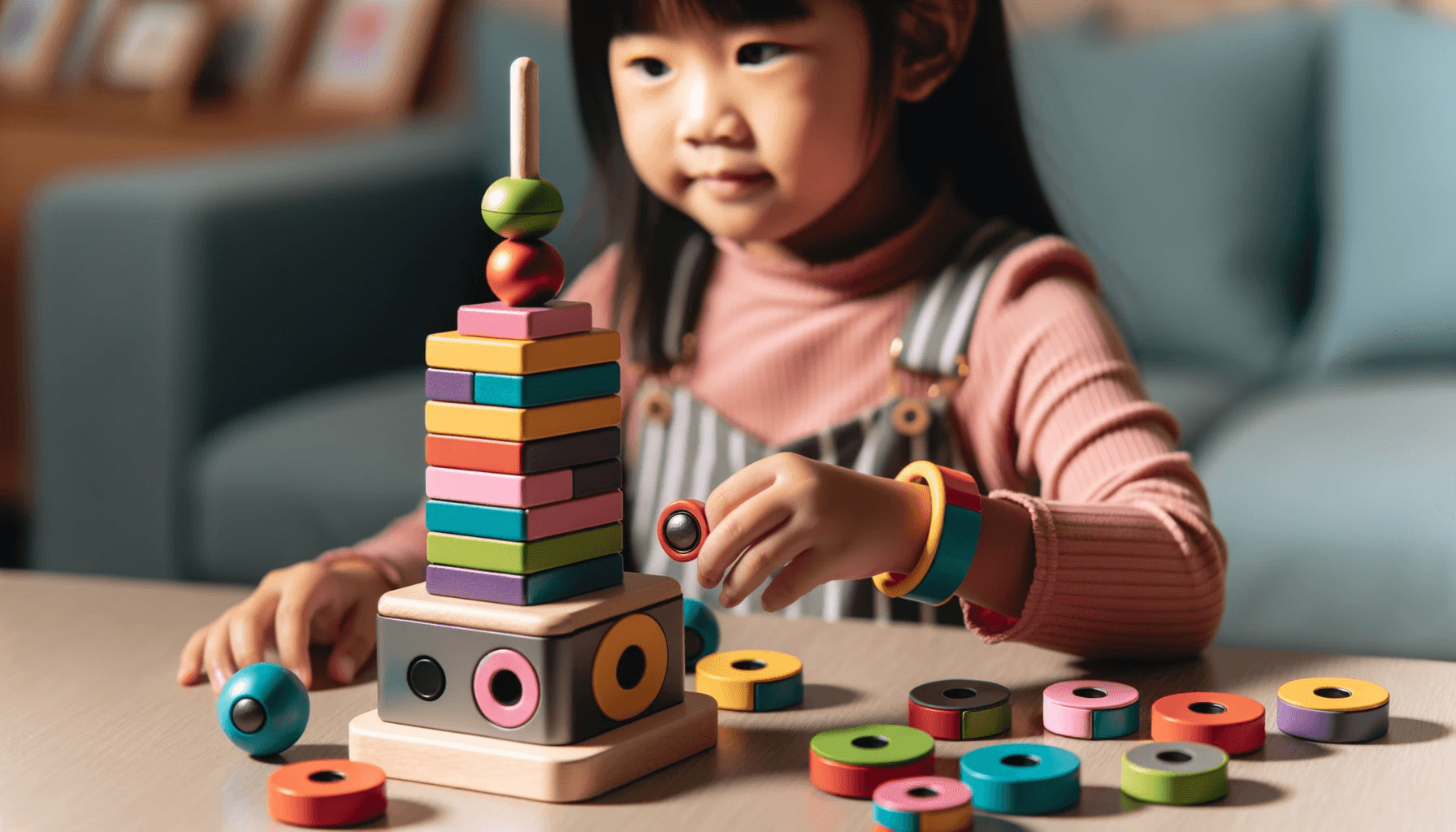
Our innovative use of magnets became the project's cornerstone. We envisioned a wristband embedded with a neodymium magnet, allowing children to effortlessly lift the toy. The critical breakthrough was the implementation of magnetic strips within the stackable elements and the dowel. This design ensured a smooth detachment process, a stark contrast to the struggles we observed with Velcro in previous adaptations. After meticulous experimentation with various magnets, we achieved the delicate balance necessary for easy attachment and release.
The journey involved numerous iterations, especially regarding the size of the hole of the stackables. Striking a balance between adequate space for the magnetic strips and user-friendly dimensions was painstaking but crucial. The 3D printing process was labor-intensive, compounded by unforeseen obstacles like material shortages. However, overcoming these challenges was a testament to our team's resilience and commitment.
Texture addition was another critical aspect. By integrating various fabrics, we endowed the shapes with unique tactile characteristics. This feature not only contributes to the sensory experience but also aids in the toy's universal design, accommodating children with color vision deficiencies or visual impairments.
Concurrently, we engineered the toy's wooden base, ensuring stability and functionality. Precise laser cutting techniques facilitated the creation of a hollow but durable structure, which also provided the flexibility to adjust the toy's weight as needed.
As our project neared completion, one of the most pivotal yet challenging steps was the integration of the magnets and magnetic strips. The complexity of this process lay not just in the physical installation but the continuous interactions of the magnets with each other.
The small round magnets, integral to our design, presented a significant challenge. Their diminutive size, coupled with their strong magnetic interactions, made them exceptionally difficult to secure in place. Our initial attempts using hot glue proved futile—the magnets, defying the adhesive, seemed almost eager to leap away, propelled by their mutual repulsion or attraction. We encountered an additional hurdle with the magnetic strips designated for the interior of the stackable toys and the dowel. Unlike their round counterparts, these strips were rigid, resisting any attempts at bending. This rigidity necessitated that we cut them into smaller sections to line the insides of the stackable holes, a task requiring both precision and patience. Each segment had to be perfectly sized to sit within the confines of its designated space.
Perhaps the most critical aspect during this phase was managing the magnetic poles. The importance of this task couldn't be overstated—one misstep, and the magnets would repel each other, a scenario that would undermine the entire functionality of the toy. Ensuring that each magnet was correctly oriented according to its pole was a painstaking process, requiring our utmost attention and care. After grappling with several adhesives, we discovered that superglue provided the most reliable bond for the magnets. However, this solution brought its own set of challenges. Applying it within the confined spaces of the stackables was a delicate operation, given the glue's fast-drying nature and our limited access to the toy's interior sections. Moreover, we found that not all materials were receptive to superglue. One particular fabric texture defied its hold, prompting us to devise a hybrid approach using both superglue and hot glue. This combination, though unconventional, proved effective, securing the magnets where other adhesives had failed.
After several iterations, we successfully lined the interiors of the stackables with magnetic strips and affixed the small round magnets to the stackable exteriors, always mindful of the crucial magnetic poles. The completion of this stage was a significant milestone, marking our readiness to proceed with the final assembly.
In the final assembly stage, we encountered another hurdle with the wristband. Our initial design, incorporating multiple magnets, was impractical due to the added weight and complexity. We reverted to a single magnet design, repurposing a child's watch strap and enhancing it aesthetically with thoughtful touches like a custom sticker.
The moment of truth arrived with the first comprehensive test of our assembled product, and it was nothing short of a success. Each component functioned harmoniously, and even the magnetic strips, initially underestimated, provided the perfect counterbalance for detachment. An unexpected outcome was the 'floating' stackables (due to the higher strength of the magnetic strips), a fascinating quirk that added an element of wonder for the children. What might have been seen as a flaw transformed into a unique feature, underscoring the beauty of serendipity in design.
Our project has led to the creation of a product that we're truly happy with, emphasizing the importance of inclusive design. Recognizing the challenges faced by children with specific needs, we've aimed to create more than just a toy—it's a tool designed to engage and bring joy. This journey has taught us the value of empathy and focusing on the user. We're grateful for the chance to contribute to a future where inclusivity is a natural part of design, and where every child can experience the joy of play without limitations.
___
Venture through our progress!
Team: Swostik, Ruhsona, Jaden
As we approached the concluding phase of our project, the last few weeks were a whirlwind of rapid prototyping, testing, feedback, and iterative design. Each step of the process was crucial, bringing us closer to our goal: a high-fidelity, inclusive stacking toy adapted for children with limited muscular strength and fine motor skills. Embarking on the creation of our final product, we prioritized material selection to ensure durability and practicality. We opted for a wooden base and dowel, recognizing the strength required to withstand the rigors of enthusiastic play and potential mishaps. These choices were validated by insights from our mind-mapping sessions, emphasizing the necessity for robust construction.
The stackable elements posed a unique challenge, leading us to embrace 3D printing for these components. This method offered multiple advantages: seamless production of whole units, ease of iterative testing, and the capability to adjust dimensions swiftly. Furthermore, 3D printing facilitated experimentation with textures, enhancing tactile feedback essential for user interaction. After evaluating various materials, we settled on TPU for its softer quality compared to conventional options like PLA.
Our innovative use of magnets became the project's cornerstone. We envisioned a wristband embedded with a neodymium magnet, allowing children to effortlessly lift the toy. The critical breakthrough was the implementation of magnetic strips within the stackable elements and the dowel. This design ensured a smooth detachment process, a stark contrast to the struggles we observed with Velcro in previous adaptations. After meticulous experimentation with various magnets, we achieved the delicate balance necessary for easy attachment and release.
The journey involved numerous iterations, especially regarding the size of the hole of the stackables. Striking a balance between adequate space for the magnetic strips and user-friendly dimensions was painstaking but crucial. The 3D printing process was labor-intensive, compounded by unforeseen obstacles like material shortages. However, overcoming these challenges was a testament to our team's resilience and commitment.
Texture addition was another critical aspect. By integrating various fabrics, we endowed the shapes with unique tactile characteristics. This feature not only contributes to the sensory experience but also aids in the toy's universal design, accommodating children with color vision deficiencies or visual impairments.
Concurrently, we engineered the toy's wooden base, ensuring stability and functionality. Precise laser cutting techniques facilitated the creation of a hollow but durable structure, which also provided the flexibility to adjust the toy's weight as needed.
As our project neared completion, one of the most pivotal yet challenging steps was the integration of the magnets and magnetic strips. The complexity of this process lay not just in the physical installation but the continuous interactions of the magnets with each other.
The small round magnets, integral to our design, presented a significant challenge. Their diminutive size, coupled with their strong magnetic interactions, made them exceptionally difficult to secure in place. Our initial attempts using hot glue proved futile—the magnets, defying the adhesive, seemed almost eager to leap away, propelled by their mutual repulsion or attraction. We encountered an additional hurdle with the magnetic strips designated for the interior of the stackable toys and the dowel. Unlike their round counterparts, these strips were rigid, resisting any attempts at bending. This rigidity necessitated that we cut them into smaller sections to line the insides of the stackable holes, a task requiring both precision and patience. Each segment had to be perfectly sized to sit within the confines of its designated space.
Perhaps the most critical aspect during this phase was managing the magnetic poles. The importance of this task couldn't be overstated—one misstep, and the magnets would repel each other, a scenario that would undermine the entire functionality of the toy. Ensuring that each magnet was correctly oriented according to its pole was a painstaking process, requiring our utmost attention and care. After grappling with several adhesives, we discovered that superglue provided the most reliable bond for the magnets. However, this solution brought its own set of challenges. Applying it within the confined spaces of the stackables was a delicate operation, given the glue's fast-drying nature and our limited access to the toy's interior sections. Moreover, we found that not all materials were receptive to superglue. One particular fabric texture defied its hold, prompting us to devise a hybrid approach using both superglue and hot glue. This combination, though unconventional, proved effective, securing the magnets where other adhesives had failed.
After several iterations, we successfully lined the interiors of the stackables with magnetic strips and affixed the small round magnets to the stackable exteriors, always mindful of the crucial magnetic poles. The completion of this stage was a significant milestone, marking our readiness to proceed with the final assembly.
In the final assembly stage, we encountered another hurdle with the wristband. Our initial design, incorporating multiple magnets, was impractical due to the added weight and complexity. We reverted to a single magnet design, repurposing a child's watch strap and enhancing it aesthetically with thoughtful touches like a custom sticker.
The moment of truth arrived with the first comprehensive test of our assembled product, and it was nothing short of a success. Each component functioned harmoniously, and even the magnetic strips, initially underestimated, provided the perfect counterbalance for detachment. An unexpected outcome was the 'floating' stackables (due to the higher strength of the magnetic strips), a fascinating quirk that added an element of wonder for the children. What might have been seen as a flaw transformed into a unique feature, underscoring the beauty of serendipity in design.
Our project has led to the creation of a product that we're truly happy with, emphasizing the importance of inclusive design. Recognizing the challenges faced by children with specific needs, we've aimed to create more than just a toy—it's a tool designed to engage and bring joy. This journey has taught us the value of empathy and focusing on the user. We're grateful for the chance to contribute to a future where inclusivity is a natural part of design, and where every child can experience the joy of play without limitations.
___
Venture through our progress!
Team: Swostik, Ruhsona, Jaden
As we approached the concluding phase of our project, the last few weeks were a whirlwind of rapid prototyping, testing, feedback, and iterative design. Each step of the process was crucial, bringing us closer to our goal: a high-fidelity, inclusive stacking toy adapted for children with limited muscular strength and fine motor skills. Embarking on the creation of our final product, we prioritized material selection to ensure durability and practicality. We opted for a wooden base and dowel, recognizing the strength required to withstand the rigors of enthusiastic play and potential mishaps. These choices were validated by insights from our mind-mapping sessions, emphasizing the necessity for robust construction.
The stackable elements posed a unique challenge, leading us to embrace 3D printing for these components. This method offered multiple advantages: seamless production of whole units, ease of iterative testing, and the capability to adjust dimensions swiftly. Furthermore, 3D printing facilitated experimentation with textures, enhancing tactile feedback essential for user interaction. After evaluating various materials, we settled on TPU for its softer quality compared to conventional options like PLA.
Our innovative use of magnets became the project's cornerstone. We envisioned a wristband embedded with a neodymium magnet, allowing children to effortlessly lift the toy. The critical breakthrough was the implementation of magnetic strips within the stackable elements and the dowel. This design ensured a smooth detachment process, a stark contrast to the struggles we observed with Velcro in previous adaptations. After meticulous experimentation with various magnets, we achieved the delicate balance necessary for easy attachment and release.
The journey involved numerous iterations, especially regarding the size of the hole of the stackables. Striking a balance between adequate space for the magnetic strips and user-friendly dimensions was painstaking but crucial. The 3D printing process was labor-intensive, compounded by unforeseen obstacles like material shortages. However, overcoming these challenges was a testament to our team's resilience and commitment.
Texture addition was another critical aspect. By integrating various fabrics, we endowed the shapes with unique tactile characteristics. This feature not only contributes to the sensory experience but also aids in the toy's universal design, accommodating children with color vision deficiencies or visual impairments.
Concurrently, we engineered the toy's wooden base, ensuring stability and functionality. Precise laser cutting techniques facilitated the creation of a hollow but durable structure, which also provided the flexibility to adjust the toy's weight as needed.
As our project neared completion, one of the most pivotal yet challenging steps was the integration of the magnets and magnetic strips. The complexity of this process lay not just in the physical installation but the continuous interactions of the magnets with each other.
The small round magnets, integral to our design, presented a significant challenge. Their diminutive size, coupled with their strong magnetic interactions, made them exceptionally difficult to secure in place. Our initial attempts using hot glue proved futile—the magnets, defying the adhesive, seemed almost eager to leap away, propelled by their mutual repulsion or attraction. We encountered an additional hurdle with the magnetic strips designated for the interior of the stackable toys and the dowel. Unlike their round counterparts, these strips were rigid, resisting any attempts at bending. This rigidity necessitated that we cut them into smaller sections to line the insides of the stackable holes, a task requiring both precision and patience. Each segment had to be perfectly sized to sit within the confines of its designated space.
Perhaps the most critical aspect during this phase was managing the magnetic poles. The importance of this task couldn't be overstated—one misstep, and the magnets would repel each other, a scenario that would undermine the entire functionality of the toy. Ensuring that each magnet was correctly oriented according to its pole was a painstaking process, requiring our utmost attention and care. After grappling with several adhesives, we discovered that superglue provided the most reliable bond for the magnets. However, this solution brought its own set of challenges. Applying it within the confined spaces of the stackables was a delicate operation, given the glue's fast-drying nature and our limited access to the toy's interior sections. Moreover, we found that not all materials were receptive to superglue. One particular fabric texture defied its hold, prompting us to devise a hybrid approach using both superglue and hot glue. This combination, though unconventional, proved effective, securing the magnets where other adhesives had failed.
After several iterations, we successfully lined the interiors of the stackables with magnetic strips and affixed the small round magnets to the stackable exteriors, always mindful of the crucial magnetic poles. The completion of this stage was a significant milestone, marking our readiness to proceed with the final assembly.
In the final assembly stage, we encountered another hurdle with the wristband. Our initial design, incorporating multiple magnets, was impractical due to the added weight and complexity. We reverted to a single magnet design, repurposing a child's watch strap and enhancing it aesthetically with thoughtful touches like a custom sticker.
The moment of truth arrived with the first comprehensive test of our assembled product, and it was nothing short of a success. Each component functioned harmoniously, and even the magnetic strips, initially underestimated, provided the perfect counterbalance for detachment. An unexpected outcome was the 'floating' stackables (due to the higher strength of the magnetic strips), a fascinating quirk that added an element of wonder for the children. What might have been seen as a flaw transformed into a unique feature, underscoring the beauty of serendipity in design.
Our project has led to the creation of a product that we're truly happy with, emphasizing the importance of inclusive design. Recognizing the challenges faced by children with specific needs, we've aimed to create more than just a toy—it's a tool designed to engage and bring joy. This journey has taught us the value of empathy and focusing on the user. We're grateful for the chance to contribute to a future where inclusivity is a natural part of design, and where every child can experience the joy of play without limitations.
___
Venture through our progress!